
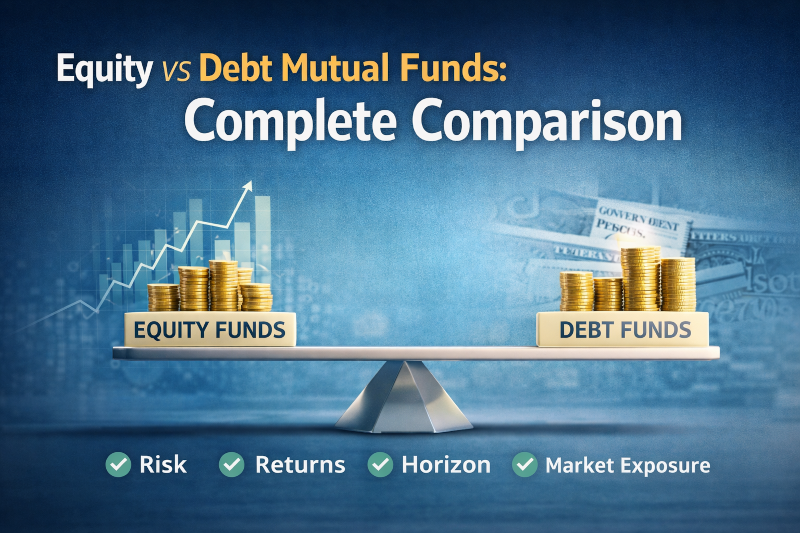
Mutual funds offer different investment options to suit the financial needs and risk appetite of investors. Among the most common categories are equity mutual funds and debt mutual funds. Understanding the difference between these two types is important before making any mutual fund investment. A professional mutual fund distributor can help investors choose the right option based on their financial objectives.
What are Equity Mutual Funds?
Equity mutual funds primarily invest in shares of listed companies. The main objective of these funds is long-term capital growth. Since these funds are linked to stock market performance, they may offer higher return potential but also carry higher market risk.
Equity funds are generally suitable for investors who have a long-term investment horizon, usually five years or more, and who can tolerate short-term market fluctuations.
What are Debt Mutual Funds?
Debt mutual funds invest mainly in fixed-income instruments such as government securities, corporate bonds, treasury bills, and other money market instruments. The objective of debt funds is to provide relatively stable returns with lower volatility compared to equity funds.
These funds are often preferred by investors seeking stability, regular income, or those with a shorter investment horizon.
Key Differences Between Equity and Debt Mutual Funds
1. Risk Level
Equity funds generally carry higher market risk, while debt funds are relatively more stable.
2. Return Potential
Equity mutual funds have higher return potential over the long term, whereas debt funds typically provide moderate but more predictable returns.
3. Investment Horizon
Equity funds are suitable for long-term wealth building, while debt funds are often chosen for short- to medium-term financial objectives.
4. Market Exposure
Equity funds invest in the stock market, whereas debt funds invest in fixed-income securities.
Conclusion
Both equity and debt funds play an important role in building a balanced investment portfolio. The right mutual fund investment strategy often includes a combination of both, depending on the investor’s risk tolerance, financial objectives, and time horizon. Guidance qualified mutual fund distributor can help in selecting suitable schemes and maintaining a diversified portfolio.
Disclaimer: Mutual Fund investments are subject to market risks. Please read all scheme related documents carefully before investing. Past performance may or may not be sustained in the future. This article is for informational purposes only and should not be considered as investment advice. Investors should consult their financial distributor before making any investment decisions, in accordance with the guidelines of the Securities and Exchange Board of India (SEBI) and the Association of Mutual Funds in India (AMFI).